


Table of Contents
An LCL tear can cause significant difficulties with normal knee movement, and make every day tasks difficult to impossible.
If you’re here, you probably already suspect what’s going on and want to know one thing: does this need surgery? Dr. Pamela Mehta at Resilience Orthopedics can tell you, based on your knee rather than a general rule.
Book a Consultation with Dr. Pamela Mehta, MD
The Best Orthopedic Surgeon in San Jose
Dr. Mehta is a board-certified orthopedic surgeon who can help you recover from your joint condition. If you:
- Are Suffering From Pain and Mobility Issues
- Need Orthopedic Assessment and Advice
- Want Treatment From a Top Orthopedic Doctor
We Can Help
What is an LCL Tear?
LCL tears occur when the ligament running along the outside of the knee is stretched or torn, usually from a force that pushes the knee outward.
It’s the least commonly injured of the four knee ligaments, and rarely occurs on its own – it often involves the posterolateral corner or the PCL, which changes how it’s treated.
Common causes include:
- A direct blow to the inside of the knee
- A twisting injury during sports
- Hyperextension of the knee
- Falls or motor vehicle accidents
Symptoms may include pain and tenderness along the outside of the knee, swelling, a feeling of instability, and difficulty bearing weight.

Does an LCL Tear Need Surgery?
The honest answer is that it depends on the grade and what else is involved – which is exactly why this needs an exam and imaging rather than a search result.
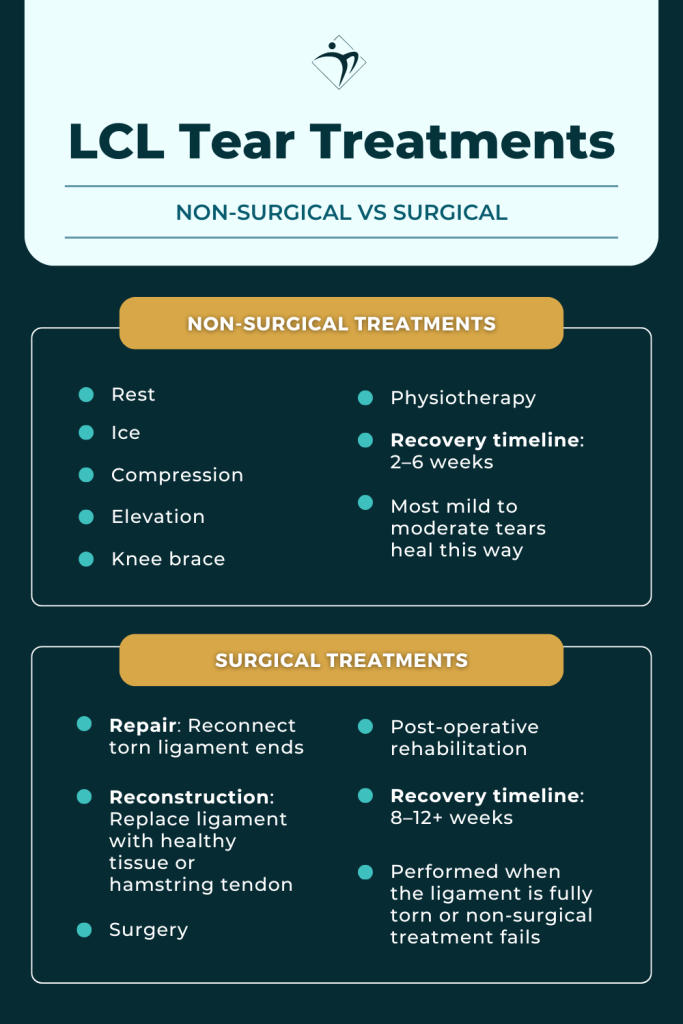
Isolated grade 1–2 tears are often managed with bracing and rehab. Grade 3 tears, or tears combined with other ligament damage, more often need surgical reconstruction.
How We Treat LCL Tears at Resilience Orthopedics
Your First Appointment
Dr. Mehta will ask specifically how the knee was struck or twisted, since a blow from the inside points strongly toward the LCL. She’ll test the ligament’s stability directly, and check for the associated injuries that so often travel with an LCL tear.
MRI is used routinely here, not just for confirmation – LCL tears are easy to miss on X-ray, and the associated damage is often what actually determines treatment.

Your Personalized Treatment Plan
For an isolated, lower-grade tear, treatment is bracing followed by a structured rehab program to rebuild strength and stability.
For a complete tear, or one combined with other ligament damage, Dr. Mehta will talk through surgical reconstruction – including what’s actually being repaired and why, since “LCL surgery” often means addressing more than the LCL alone.
Recovery
Isolated lower-grade tears typically improve over six to eight weeks. Surgical reconstruction involves a longer, staged return, usually guided by strength testing rather than a calendar date — particularly important here, since the LCL is a key stabilizer for cutting and pivoting.
Why Choose Resilience Orthopedics for LCL Tear Treatment
- Genuine LCL expertise, not a generic ligament page — we look specifically for the injuries that commonly accompany an LCL tear.
- MRI as standard, so nothing associated gets missed.
- A clear answer on surgery, based on your grade and your knee.
- The same surgeon throughout, from diagnosis to full return to activity.
You deserve movement without pain. Book a consultation with Dr. Pamela Mehta to get a personalized treatment plan.
FAQS
What Does an LCL Tear Feel Like?
Pain and tenderness down the outside of the knee, often with a sense that the knee is unstable when you plant on that side. Swelling is usually present but tends to be less pronounced than with an ACL or MCL tear.
How Long Does an LCL Tear Take to Heal?
An isolated lower-grade tear typically improves over six to eight weeks. A complete tear, especially one involving other structures, usually needs surgery and a longer, staged recovery.
Is an LCL Tear Worse Than an MCL Tear?
Not automatically, but it behaves differently. The MCL has a strong blood supply and often heals well on its own. The LCL doesn’t heal as reliably, and tears here more often come with damage to nearby structures — which is why the same grade of tear can mean two very different treatment paths depending on which ligament it is.