


Table of Contents
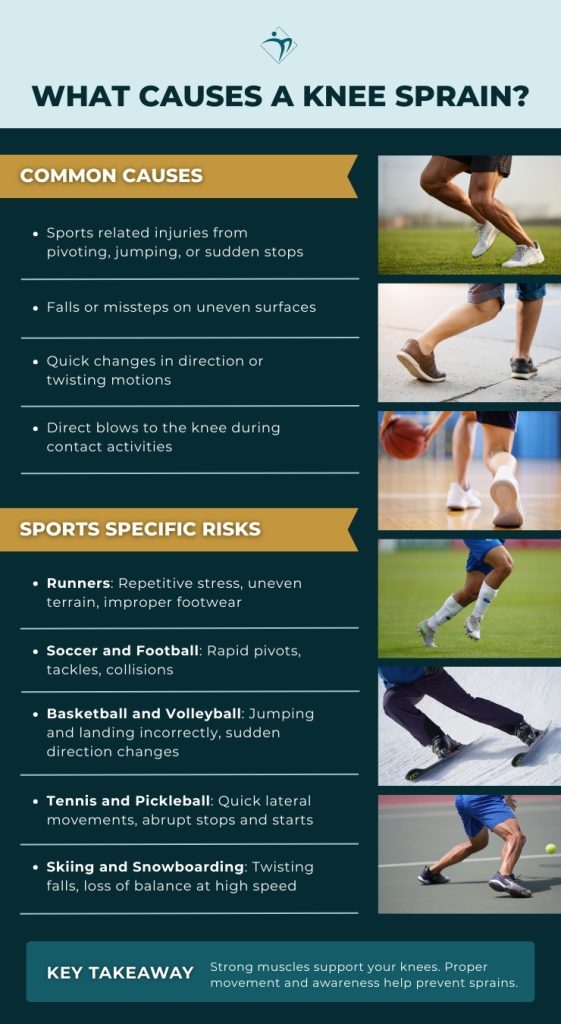
You planted your foot and turned. Or someone caught you from the side. Either way, something in your knee moved that shouldn’t have, and now you’re trying to work out how bad it is.
That’s harder than it sounds. A knee can swell within the hour or not at all. It can hurt badly and be fine, or barely hurt and be seriously torn. Pain is not a reliable guide to what you’ve done.
Most knee sprains heal without surgery. But which ligament you’ve injured, and how far, changes everything about what happens next. Dr. Pamela Mehta at Resilience Orthopedics will tell you which one you’re dealing with.
Book a Consultation with Dr. Pamela Mehta, MD
The Best Orthopedic Surgeon in San Jose
Dr. Mehta is a board-certified orthopedic surgeon who can help you recover from your joint condition. If you:
- Are Suffering From Pain and Mobility Issues
- Need Orthopedic Assessment and Advice
- Want Treatment From a Top Orthopedic Doctor
We Can Help
What is a Knee Sprain?
A sprain means a ligament has been stretched or torn. Ligaments are the tough bands holding the knee together — this isn’t a muscle problem.
Four ligaments do that job:
- MCL (Medial Collateral Ligament) – inside of the knee. Usually injured by a blow to the outside of the leg.
- LCL (Lateral Collateral Ligament) – outside of the knee. Less commonly injured on its own.
- ACL (Anterior Cruciate Ligament) – deep inside the joint. Typically a twist, a sudden stop, or an awkward landing.
- PCL (Posterior Cruciate Ligament) – also deep inside. Usually a direct hit to the front of a bent knee.

How Bad Is It? The Three Grades
Every sprain is graded on how much of the ligament has gone.
- Grade 1 – stretched. The ligament is damaged but intact. Tender in one specific spot, mild swelling, and the knee still feels solid underneath you. Most settle in two to four weeks.
- Grade 2 – partially torn. More swelling, more pain, and the knee starts to feel loose or unreliable. Usually four to eight weeks, often in a brace.
- Grade 3 – completely torn. Significant instability, and the knee may give way when you try to turn on it. Whether this needs surgery depends almost entirely on which ligament it is.
How We Treat Knee Sprains at Resilience Orthopedics
Your First Appointment
Dr. Mehta will want the mechanism in detail – what happened, what you were doing, what you felt at the time. The way an injury happens usually points straight at the ligament involved.
She’ll then test each ligament by hand for stability. An X-ray rules out a fracture, and an MRI is ordered when a significant tear is suspected or when the picture doesn’t add up.

Your Personalized Treatment Plan
For grade 1 and 2 sprains, treatment is protection followed by progressive loading – usually bracing, then physical therapy to rebuild strength and control before you return to full activity.
For grade 3, it depends on the ligament. An MCL tear frequently heals without surgery. An LCL tear, particularly with other structures involved, more often needs surgical repair. Dr. Mehta will talk you through both routes and what each means for your timeline.
Recovery and Rehabilitation
Grade 1 sprains generally take two to four weeks, grade 2 four to eight, and grade 3 considerably longer.
The most common reason people end up back for more treatment is returning too early. A knee that feels fine walking is not necessarily a knee that’s ready to change direction under load. Dr. Mehta clears you on what the knee can actually do, not on the calendar.
Why Choose Resilience Orthopedics for Knee Sprain Treatment
- Straight answers on timelines. Including when the honest answer is that it’s too early to say.
- A diagnosis, not a guess. Hands-on testing plus imaging where it’s warranted, so you know exactly which ligament and which grade.
- Surgery is a last resort. Most sprains here are managed without an operation.
- The same surgeon throughout. Dr. Mehta sees you from first visit through to clearing you for sport.
FAQs
You often can’t tell on your own, which is the honest answer. A pop at the moment of injury, swelling within an hour, or a knee that gives way all point towards a significant tear rather than a mild sprain — but a torn ACL can be surprisingly painless once the initial swelling settles. If any of those apply, get it examined.
Grade 1 sprains usually do. Grade 2 generally heal without surgery but do better with bracing and structured rehab. Grade 3 depends on the ligament — the MCL has a good blood supply and often heals, the ACL usually doesn’t.
Two to four weeks for a grade 1, four to eight for a grade 2. Grade 3 sprains take months, with or without surgery.
If you can walk without the knee giving way, gentle weight-bearing is usually fine and helps recovery. If it buckles, or you’re limping heavily to protect it, stop and get it looked at first.