


Outer hip pain can make walking, climbing stairs, getting out of a chair, or sleeping on your side uncomfortable. Hip bursitis is common among runners, cyclists, hikers, active adults, and people whose work keeps them on their feet.
Early treatment can help prevent ongoing pain and reduce the risk of tendon damage, weakness, and loss of mobility.
At Resilience Orthopedics in Los Gatos, we identify the cause of your hip pain and create a treatment plan to relieve pain, restore movement, and help you get back to the activities you enjoy.
Table of Contents
What is Hip Bursitis?
Hip bursitis is inflammation of a bursa, the small fluid-filled sac that cushions the hip joint. The two most common types are trochanteric bursitis (also called greater trochanteric pain syndrome) and iliopsoas bursitis.
Hip bursitis often develops from repetitive movement, overuse, a sudden increase in activity, or a fall.
Common symptoms include:
- Outer hip pain and tenderness
- Pain when walking, exercising, or lying on the affected side
- Pain that spreads down the outer thigh
- Stiffness after sitting
Symptoms may gradually worsen and should be evaluated early to prevent further damage.

How We Treat Hip Bursitis at Resilience Orthopedics
First Appointment
During your first visit, Dr. Pamela Mehta reviews your symptoms, evaluates your hip function, and considers your lifestyle, work, and activity goals.
X-rays are taken at your first appointment unless you have recent imaging to rule out arthritis or other bony causes. Ultrasound or MRI may be recommended if gluteal tendon tears or other soft tissue damage are suspected.
Personalized Treatment Plan
Once we understand your injury, we create a non-surgical treatment plan when appropriate.
This may include:
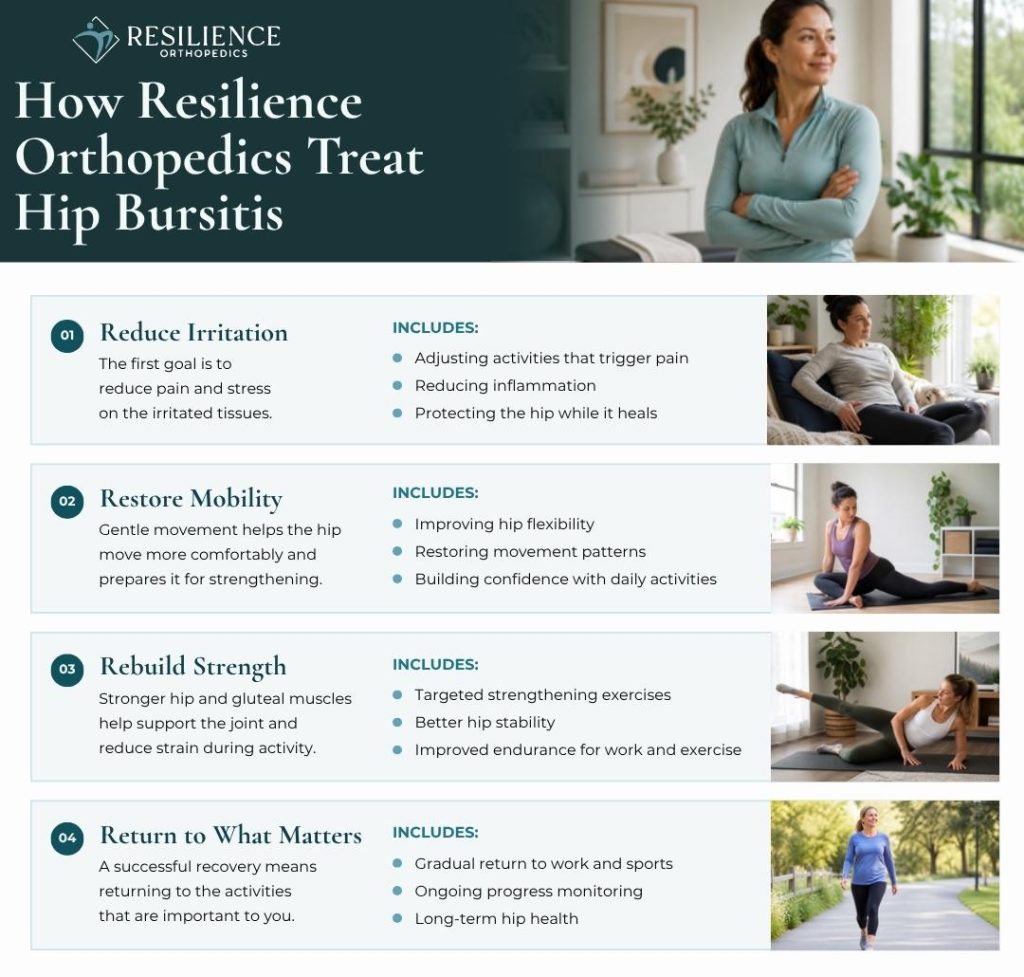
- Activity changes to reduce irritation
- Physical therapy to restore strength and mobility
- Anti-inflammatory treatments
- Image-guided injections when appropriate
Surgery, such as bursa removal or gluteal tendon repair, is only considered if non-surgical treatments are ineffective or significant structural damage is present.

Recovery and Rehabilitation
Recovery looks different for everyone and depends on the severity of your condition and the treatment you receive.
Many people improve within weeks with activity changes and physical therapy, while others may need more time to regain strength and function.
Physical therapy plays an important role in recovery by restoring mobility, strengthening the hip and gluteal muscles, and helping you safely return to work.
We’ll guide you through each step of the process and monitor your progress to support lasting hip health.
Why Choose Resilience Orthopedics for Hip Bursitis Treatment
Orthopedic-led care: Dr. Pamela Mehta manages your care from evaluation through recovery, drawing on her experience treating athletes, active adults, and patients with repetitive-use injuries.
Personalized treatment: Your plan considers your work, activities, and goals, with non-surgical options prioritized whenever appropriate.
Advanced diagnostics: A detailed exam, along with X-ray, ultrasound, or MRI when needed, helps identify the source of your pain and guide treatment.
Convenient access: With offices in Los Gatos and San Jose, specialized hip care is within reach.
FAQs
How Do I Know If My Hip Pain Is Bursitis?
Hip bursitis often causes pain and tenderness over the outer hip. You may notice pain when walking, exercising, climbing stairs, or lying on the affected side. Some people also feel stiffness or discomfort after sitting for a long time.
Can Hip Bursitis Get Better Without Surgery?
Yes. Most people improve with non-surgical treatment, including activity changes, physical therapy, medication, and image-guided injections when needed.
Surgery is considered only when pain continues despite treatment or when significant tendon damage is present.
When Should I See a Doctor for Hip Pain?
If hip pain is limiting your daily activities, affecting your sleep, or not improving with rest and activity changes, an evaluation can help identify the cause and guide treatment.
Early care may help prevent symptoms from becoming more difficult to manage.