


Wrist tendonitis often starts as a mild ache but can make gripping, lifting, typing, and everyday tasks painful.
Common in athletes and people who perform repetitive hand movements, it can worsen over time and lead to tendon damage or weaker grip strength.
If wrist pain is getting in the way of your daily life, Resilience Orthopedics can help you find answers and relief.
Table of Contents
What is Wrist Tendonitis?
Wrist tendonitis occurs when the tendons that help move your wrist and thumb become irritated or inflamed.
It can involve several conditions, including De Quervain’s tenosynovitis, intersection syndrome, and ECU or FCR tendonitis.
Common causes include:
- Repetitive computer or desk work
- Sports like tennis, golf, climbing, and weightlifting
- Manual labor or frequent hand use
- Sudden increase in activity
- Wrist injuries
Symptoms may include pain, swelling, tenderness, weakness with gripping, and pain with wrist or thumb movement.

How We Treat Wrist Tendonitis at Resilience Orthopedics
Your First Appointment
Your first visit focuses on understanding what’s causing your wrist pain.
Dr. Pamela Mehta will review your symptoms, daily activities, and pain triggers. She will also perform a physical exam to check wrist movement, tendon tenderness and grip strength.
X-rays may be used to rule out other problems, such as fractures or arthritis. If needed, ultrasound or MRI can evaluate tendon or soft tissue damage.

Your Personalized Treatment Plan
Most cases of wrist tendonitis improve without surgery. Treatment may include:
- Bracing or splinting
- Physical therapy
- Activity changes
- Medication or image-guided injections to reduce pain and inflammation
Dr. Mehta only recommends surgery when non-surgical treatments do not provide relief or when tendon damage requires repair.
Recovery and Rehabilitation After Wrist Tendonitis Treatment
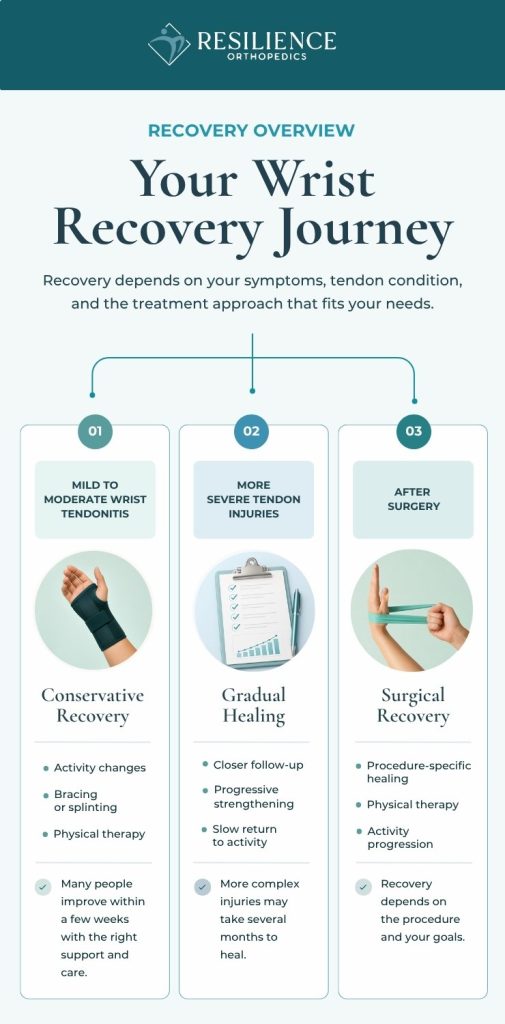
Your recovery depends on the severity of your tendon irritation, how long you’ve had symptoms, and the treatment that’s right for you.
Here’s what it may look like:
- Mild to moderate wrist tendonitis: Many people improve within a few weeks with activity changes, bracing, and physical therapy.
- More severe tendon injuries: When tendons take longer to heal, recovery may take several months, with follow-up and a more gradual return to activity.
- After surgery: Recovery will depend on the procedure and your activity level. Usually, it takes several weeks to a few months.
At Resilience Orthopedics, we guide you through every step of recovery. We help you rebuild strength and return to the activities you enjoy.
Why Choose Resilience Orthopedics for Wrist Tendonitis Treatment?
When you choose Resilience Orthopedics, you can expect:
- Expert orthopedic care from Dr. Pamela Mehta, a board-certified orthopedic surgeon
- Clear answers through a thoughtful evaluation
- A treatment plan built around your needs
- Surgery only when it’s truly needed
FAQs
What Does Wrist Tendonitis Feel Like?
Wrist tendonitis can cause a dull ache or sharp pain in the wrist or thumb area. It may become worse with gripping, lifting, twisting, or repetitive movements.
You may also notice swelling, tenderness, weakness, or pain that makes everyday activities harder.
Can Wrist Tendonitis Heal Without Surgery?
Yes. Many people improve with non-surgical treatments such as bracing, activity modifications, physical therapy, and medication.
Surgery is only needed when other treatments have not helped or when there is significant tendon damage.
What Happens if Wrist Tendonitis Is Untreated?
Without treatment, wrist tendonitis can worsen and become harder to manage over time.
Early evaluation can help protect your wrist function and prevent the problem from worsening.





