

Table of Contents
Everyday tasks like lifting, typing, or holding a golf club can cause inner elbow pain. This pain is usually caused by golfer’s elbow, also known as medial epicondylitis, which develops due to repeated stress on the forearm tendons.
At Resilience Orthopedics, Dr. Pamela Mehta helps patients in Los Gatos, San Jose, and nearby communities recover safely with personalized treatment plans.
Book a Consultation with Dr. Pamela Mehta, MD
The Best Orthopedic Surgeon in San Jose
Dr. Mehta is a board-certified orthopedic surgeon who can help you recover from your joint condition. If you:
- Are Suffering From Pain and Mobility Issues
- Need Orthopedic Assessment and Advice
- Want Treatment From a Top Orthopedic Doctor
We Can Help
What is Golfer’s Elbow?
Golfer’s elbow occurs when the tendons that connect your forearm muscles to your elbow become irritated or damaged from overuse.
Over time, this can cause pain, weakness, and stiffness in the elbow and forearm. You may be at higher risk if you:
- Do repetitive gripping or lifting
- Play racquet or throwing sports
- Recently increased the intensity of your workouts
- Work in a manual job or spend long hours at a desk
- Have muscle imbalances in your arm or shoulder
Golfer’s Elbow vs Tennis Elbow
Golfer’s elbow and tennis elbow are often confused. Understanding the differences can help you get the right treatment quickly.
| Feature | Golfer’s Elbow | Tennis Elbow |
| Pain location | Inner part of the elbow, where the arm bends toward the body | Outer part of the elbow, where the arm bends away from the body |
| Cause | Overuse of the muscles that bend the wrist | Overuse of the muscles that straighten the wrist |
| Common Activities | Golf swings, throwing, lifting objects | Tennis, racquet sports, typing, lifting objects |
| Symptoms | Pain, tenderness, stiffness on inner elbow | Pain, tenderness, stiffness on outer elbow |
| Treatment | Rest, gentle stretching, physical therapy, bracing | Rest, gentle stretching, physical therapy, bracing |
| Recovery Time | 6 to 12 months | 6 to 12 months |
| Surgery | Rare, only for severe cases | Rare, required for long-lasting cases |
What Causes Golfer’s Elbow?
Some of the common causes of golfer’s elbow include:
- Golf swings or racket sports
- Weight training with poor form
- Manual labor such as carpentry, plumbing, or construction
- Repetitive computer or tool use
- Throwing sports such as baseball
- Patients who perform repetitive hand tasks may also develop carpal tunnel syndrome, a nerve compression condition in the wrist that can occur alongside golfer’s elbow.
What are the Symptoms of Golfer’s Elbow?
Symptoms often start gradually and worsen with continued use. Some of the signs include:
- Pain or tenderness on the inside of the elbow
- Elbow stiffness
- Weak grip strength
- Pain when bending the wrist or fingers
- Numbness or tingling in the ring and little finger
If you experience numbness or tingling in your ring and little fingers, this symptom may also suggest cubital tunnel syndrome, a related condition involving compression of the ulnar nerve at the elbow.
Early treatment can protect your tendons from long-term damage.
How Can I Prevent a Golfer’s Elbow?
You can lower your risk of golfer’s elbow by reducing strain on the tendon and building strength and flexibility in your arm.
Here’s what helps:
- Increase activity gradually. Avoid sudden jumps in intensity or duration.
- Use proper form in sports and at work. Small adjustments can take pressure off your elbow.
- Stretch your forearm muscles regularly.
- Strengthen your wrist and shoulder muscles.
- Give your body enough rest between activities
Exercises to Prevent Golfer’s Elbow
These simple at-home exercises can help keep your elbow strong and lower the chance of pain returning:
- Wrist Flexion and Extension: Gently bend your wrist up and down, with or without a light weight. Start with 10 slow repetitions and complete 2 to 3 sets.
- Forearm Twists: Use a resistance band or light bar. Twist your forearm in a slow, controlled motion. Aim for 10 to 12 repetitions per set.
- Pronation and Supination: Hold a light object and rotate your palm up and down. Keep the movement steady and smooth.
- Controlled Swings: Hold a light club or weight and practice slow swings. Focus on control rather than speed.
Do not push through sharp pain. Mild fatigue is normal, but if discomfort worsens you can stop. Work both arms for balance and continue exercises even after pain improves.

When Should I See a Specialist?
Visit a specialist if your elbow pain does not improve with rest, limits your daily activities, or gets worse over time.
With early treatment you can prevent long-term damage to your tendons and return to your daily activities. Get medical care right away if:
- The elbow looks deformed
- You suspect a broken bone
- You have a fever and your elbow is swollen
How is Golfer’s Elbow Diagnosed?
Dr. Mehta starts with a conversation about your symptoms and daily activities. Then she performs a detailed exam, which may include:
- A thorough physical exam
- Grip and strength testing
- Movement and flexibility assessment
- Ultrasound imaging to assess tendon health
- MRI or CT scan if symptoms are severe or persistent
Dr. Mehta uses your diagnosis to create a treatment plan that fits your goals and lifestyle.

How Do We Treat Golfer’s Elbow?
Treatment focuses on easing pain and helping the tendon heal properly. Most people improve with non-surgical care. Dr. Mehta’s goal is to help you return to daily activities and sports safely.
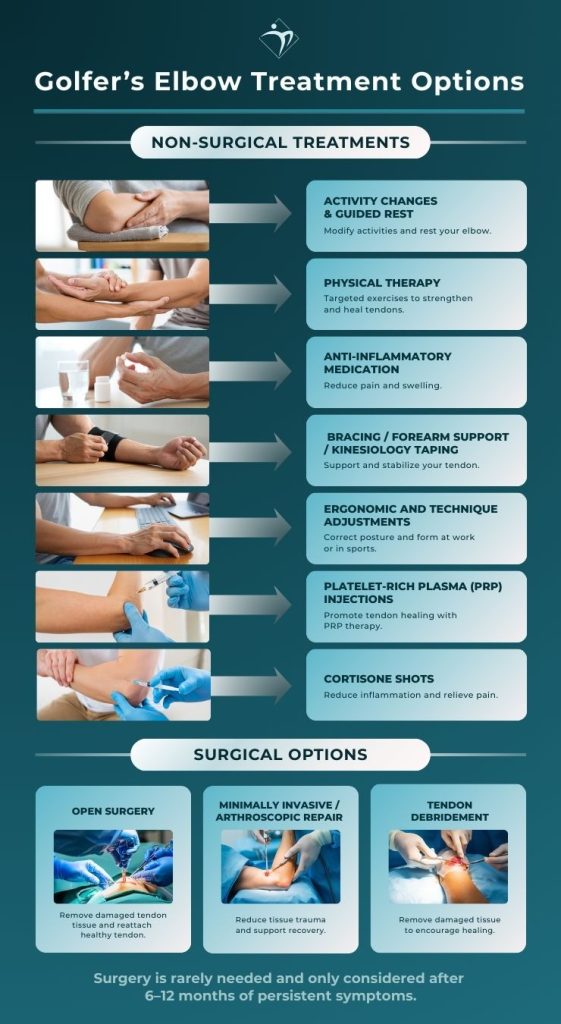
Non-surgical Treatments:
- Activity changes and guided rest
- Physical therapy with specific golfer’s elbow exercises
- Anti-inflammatory medication
- Bracing, forearm support straps, or kinesiology taping
- Ergonomic and technique adjustments
- Platelet-rich plasma (PRP) injections to support tendon healing
- Cortisone shots to reduce pain and inflammation
Surgical Options:
Surgery is rarely needed. It may be considered if pain continues after six to twelve months of consistent treatment.
Surgical options may include:
- Open surgery through a small incision on the inner elbow to remove damaged tendon tissue and reattach healthy tendon
- Minimally invasive or arthroscopic repair to reduce tissue trauma and support recovery
- Tendon debridement to remove damaged tissue and encourage healing
At Resilience Orthopedics, your treatment plan is built around you. Dr. Mehta will explain each option clearly and guide you through every step of recovery. You won’t have to go through it alone.
FAQs
Can Golfer’s Elbow Heal on its Own?
Mild cases can improve with rest, gentle stretching, and avoiding activities that strain the elbow. Persistent pain should be evaluated to prevent long-term damage.
How Long Does Recovery Take?
Recovery can range from a few weeks to several months. The timeline depends on the severity of the condition and the treatment approach.
Will I Need Surgery?
Most people recover without surgery through rest, targeted exercises, and other non-surgical treatments. Surgery is only considered if symptoms are severe, last for many months, or do not respond to conservative care.